


The Moving Picture World, the premier trade publication for the silent film industry, reported in March 1915, “The mountain section of Eastern Tennessee, with its traditions, romances, and tragedies, is to be pictured in a series of moving pictures to be made by a film producer of the East.” The author of the movie series was expected to be Edith Stow, “a successful writer of New York,” perhaps working in collaboration with a prominent local writer. Filming was to begin the next fall.

The U.S. government, under the auspices of revenue agent Knox Booth, had given permission for “his noted force of moonshine raiders to assist in making some of the pictures.” Booth was the head of the Tennessee Revenue Division, based out of Nashville.
According to the article, two famous local raiders, W. H. Tyler and W. H. Kilgore (a.k.a. W. A. Kilgore), “may become celebrated as moving picture stars.” Both men were mentioned frequently in local newspapers as the agents responsible for several successful moonshine raids.
Tyler and Kilgore will give “practical demonstrations of the operations of federal officers in the wildcatting section.” Wildcatting was a colloquial term for moonshining. Illegal whiskey was often called wildcat. The locus for this activity was in and around the Great Smoky Mountains.
Although no mention of the anticipated moving picture partnership appeared in The Knoxville Sentinel (Tennessee), both the Nashville Tennessean and the Commercial Appeal (Memphis) picked up the story and published it in early March 1915.
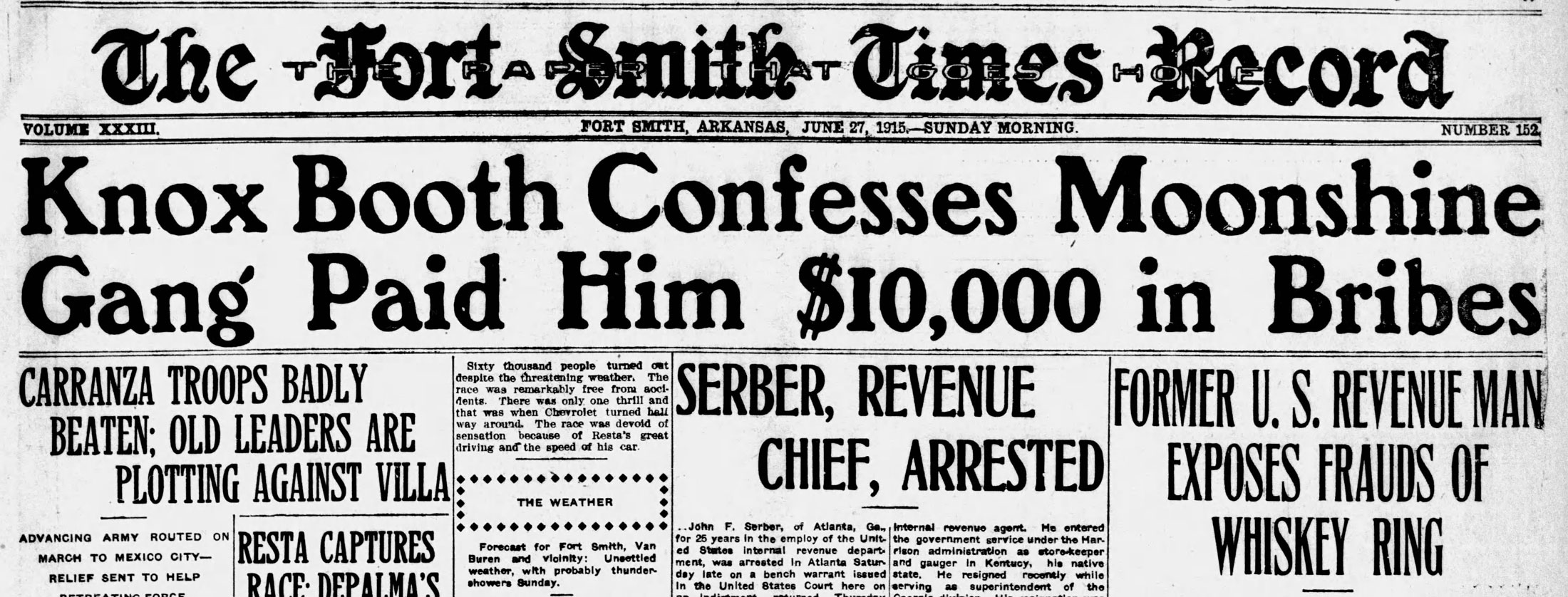
A search of The Knoxville Sentinel and other Tennessee papers produced no evidence that this partnership came to fruition. A probable reason for the failure appeared in The Knoxville Sentinel in May 1915. Agent Booth, who was supposed to act as the liaison between the filmmakers and the revenue agents, was arrested on a “charge of conspiracy to defraud the government.” In particular, the authorities alleged that he was involved in a larger case designed to defraud the government of revenue by warning illegal distillers in Fort Smith, Arkansas, when revenue agents were about to raid their operation.

The Knoxville Sentinel defended Booth by saying that he was “well and favorably known in Knoxville. . . . He has many friends both here and in Tennessee who are loath to believe the charges against him and who are confident he will be exonerated.”
However, this confidence was misplaced. Both Booth and his co-conspirators were charged with whiskey tax fraud, which cost the government approximately $100,000. Then Booth disappeared. He surrendered a few days later and admitted that he took $12,000 in bribes. His hearing was scheduled for January.
In October of that same year, before his case could be heard in federal court, the 44-year-old Booth died suddenly. According to newspaper reports, Booth was traveling from his home in Nashville to Fort Smith, Arkansas, to appear as a witness for the prosecution in the federal trial of his fellow fraud conspirators. Before he left town, he ate oysters at the Nashville train station. By his own account, the oysters gave him ptomaine poisoning, a general term used at the time for food poisoning.

The defendants pleaded guilty, relieving Booth of the obligation of testifying. A few days later Booth headed back to Nashville by train via Memphis. He collapsed in the train station and was taken to a Memphis hospital, where he later died. According to his death certificate, he died of a heart attack with “bad oysters” listed as a contributing factor. He was buried in his childhood hometown of Prattville, Alabama.
Soon after Booth’s death, rumors began circulating in Tennessee newspapers that he had been poisoned to keep him from acting as a witness against some of the defendants who had yet to be tried in the moonshine conspiracy case. Booth had confided to his wife that he feared for his safety. He had made a request for a bodyguard, but he was apparently alone on the train as it traveled from Little Rock, Arkansas, to Memphis.
The rumors of foul play in Booth’s death prompted the federal government to investigate. The agents assigned to the case traced Booth’s movements from his lunch at a Little Rock cafe to his train trip. It was determined that he did not eat at the Memphis station or leave the waiting area until he collapsed. The whiskey that Booth carried with him was tested and found not poisonous.
Ultimately, Booth’s body was exhumed to analyze the contents and condition of his digestive organs. Booth’s wife gave her permission for the exhumation, over the protests of some other family members. The Alabama state chemist conducted the analysis, concluding that Booth’s death was the result of a “malignant attack of stomach ulceration.” The chemist found no evidence of poisoning. This finding apparently ended the investigation into Booth’s death.
The fraud case and the demise of Knox Booth apparently soured the moving picture industry deal with the federal government. Subsequently, the Great Smoky Mountains and the surrounding communities missed out on a chance to become stars of the silent movie screen.
Read Anne’s blog Moonshine movies in the early film era: Part one—Themes and elements.