


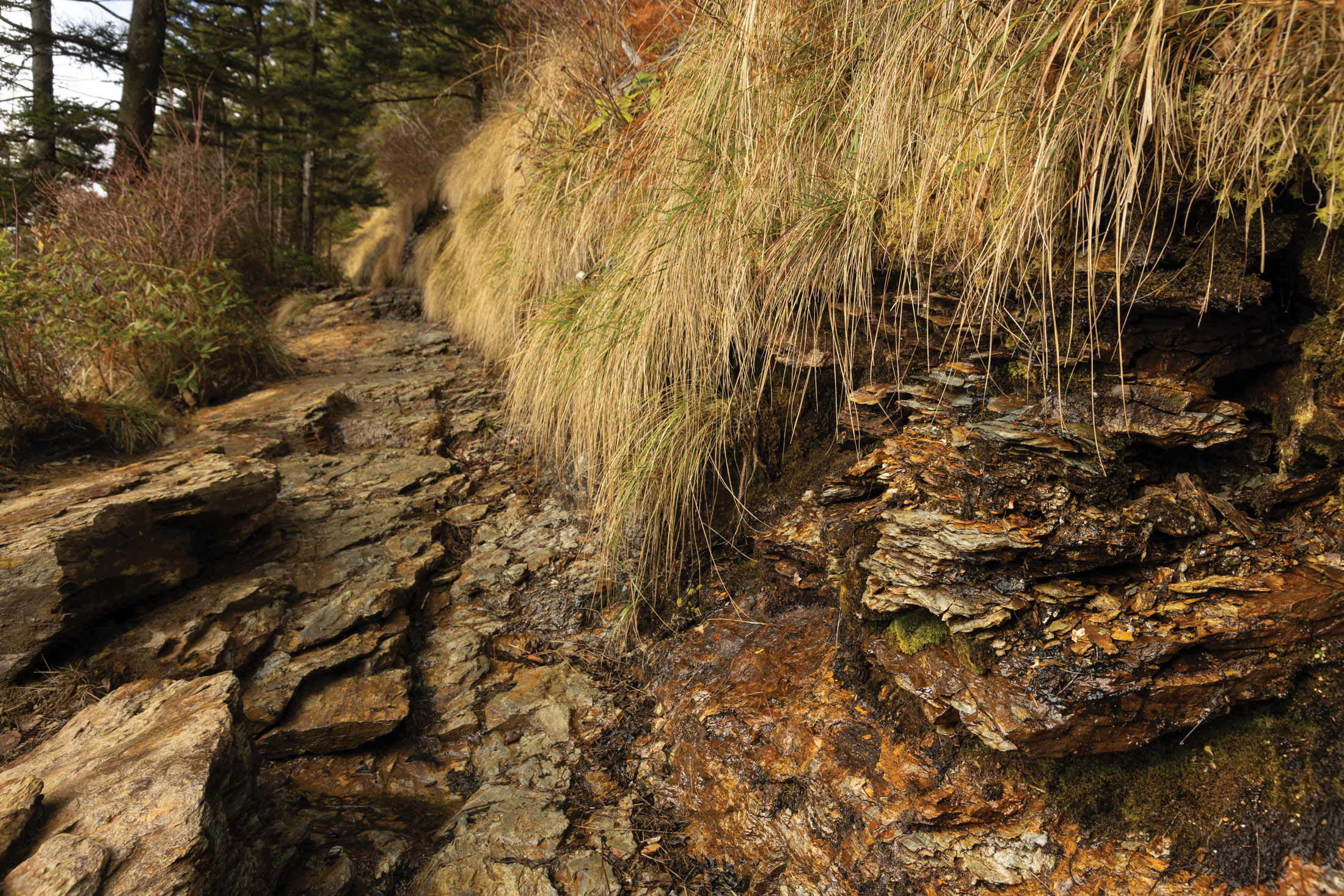
Every year, millions of people visit Great Smoky Mountains National Park to fish rushing creeks, hike wooded mountains, and glimpse wild elk and black bear. But only a fraction of these visitors ever see a wetland—such habitats cover just a tiny portion of the park’s vast acreage, and most are located in remote areas far from roads and trails. Yet they play a critical role in the Smokies’ ecology and biodiversity.
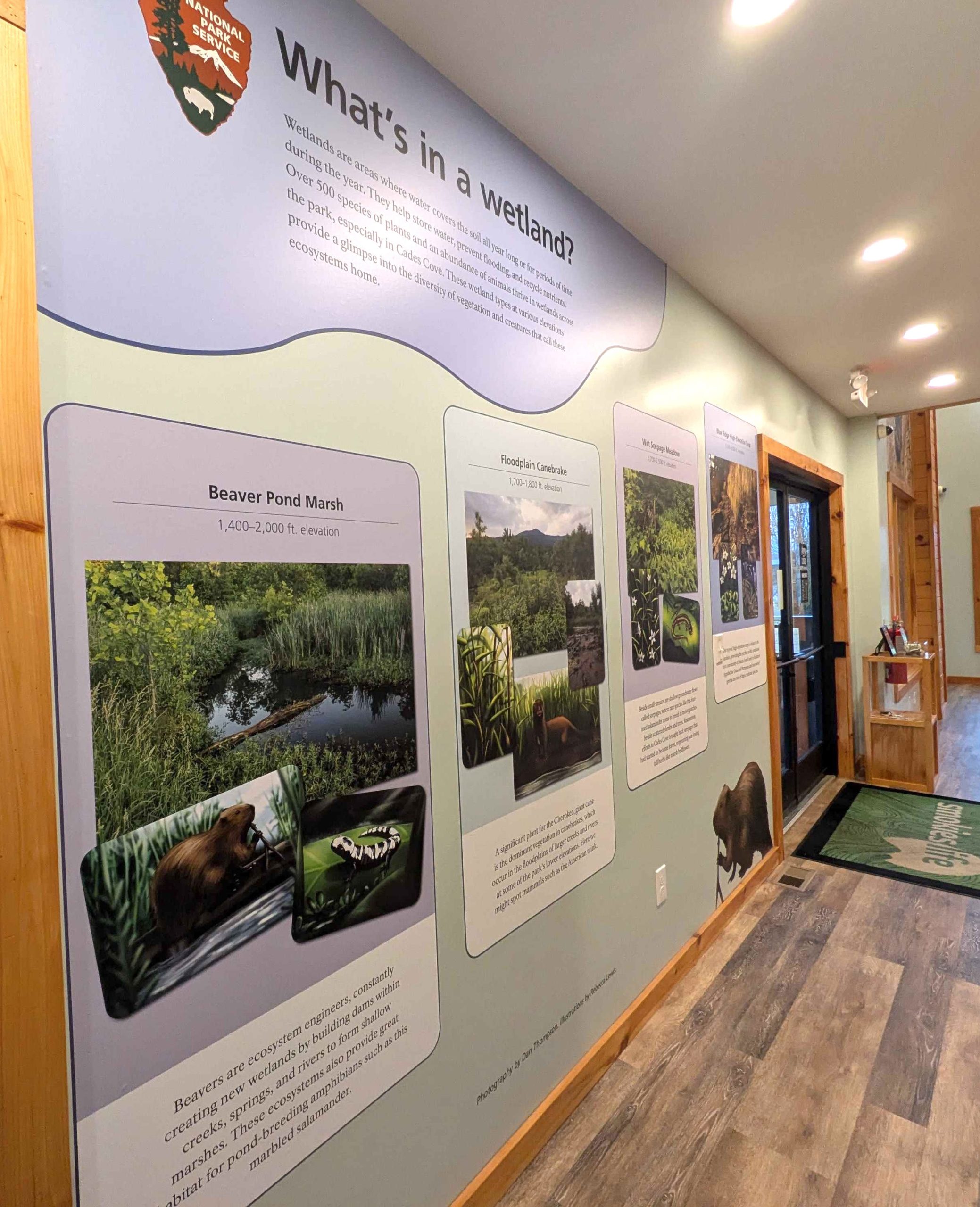
Pulling together photography, illustration, and writing, a display installed last fall at the Great Smokies Welcome Center in Townsend, Tennessee, seeks to share the wonder of these unique ecosystems in a fresh way.
“What I hope visitors take away from the display is a deeper appreciation for wetlands—both the big, obvious features and the small details that are so easy to overlook,” said Miranda Bemis, the Smokies Life graphic designer who designed the display. “I want people to walk away having learned something new, feeling a little more curious, and maybe seeing these places with fresh eyes.”
Smokies wetlands help store water, prevent flooding, and recycle nutrients. They’re also home to many animals and more than 500 species of plants—many of which are found nowhere else in the park. The display highlights these benefits as well as the varied wetland types present in the park. The Smokies contains ten distinct types of wetlands, and the display features four of them. The beaver pond marsh can be found at elevations of 1,400–2,000 feet, the floodplain canebrake at 1,700–1,800 feet, the wet seepage meadow at 1,700–2,500 feet, and the Blue Ridge high-elevation seep at 5,500–6,000 feet.
“What was fascinating to me is, none of them looked the same,” said Maryville, Tennessee, native Dan Thompson, who photographed the featured wetlands. “And that was a worry going in: Are these not all going to start to run together? And, you know, every one of them was diverse.”
Thompson has lived his entire life at the doorstep of the Smokies and spent more than three decades as a photographer making frequent pilgrimages to the park. He knows the Smokies well, but this project provided an unexpected level of discovery and adventure.
“When I think of the Smokies, ‘wetland’ is not what comes to mind,” he said. “And then when she [Smokies Life Creative Services Director Frances Figart] sent me the map and said, ‘Here’s the places I want you to photograph,’ I said, ‘Oh, I get it now. These are out there.’ That’s why you don’t think of it as wetlands, because you don’t see these parts of the park.”
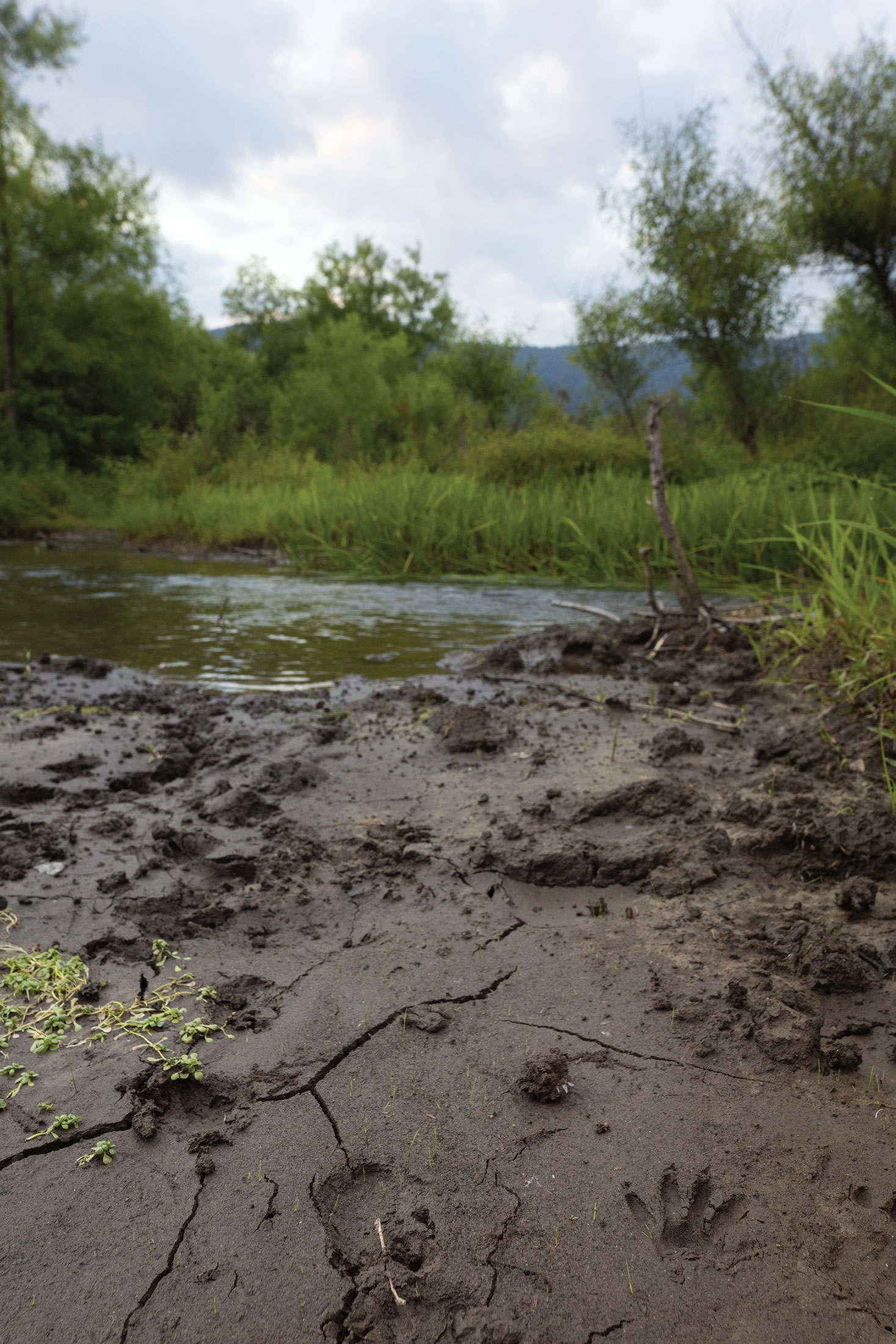
Reaching the wetlands required physical stamina, navigation skills, and tenacity. On multiple occasions, Thompson, who is 6’2”, came across wetland vegetation taller than himself, and frequently encountered obstacles such as mud and briers. During his travels, he saw calm pools of reflective water, beaver tracks, and a variety of complexly beautiful flowers and grasses. Knowing that few people would ever see these pockets of the park in person, he began to appreciate how this project supported the overall “thesis” he has for his photography work: “sharing the world with people who may not have the opportunity themselves to see it.” To achieve this goal, he visited all but one of the wetlands multiple times.
“You just need to go and see it, spend time with it, catch a view of what would not only be pretty about this spot, but what would compel people to be interested in it and perhaps want to conserve it,” he said.
But even a photograph can’t depict every detail. Camera-shy wildlife, out-of-season flowers, and tiny nuances that are difficult to capture with a lens would be better brought to life using an illustrator, the Smokies Life team decided.
“One of my goals from the start was to incorporate scientifically accurate illustrations, so finding the right illustrator felt like a crucial step,” Bemis said.
Figart suggested Rebecca Lewis, an artist she’d met during a recent trip to Ecuador that was part of a course comparing ecosystems found in that country with those in the Smokies. Lewis had recently graduated with a degree in marine science, adding a minor in illustration after a professor noticed the quality of the doodles she was making in her lecture notes. As soon as she saw Lewis’ work, Bemis said, she knew it was “the perfect fit.”
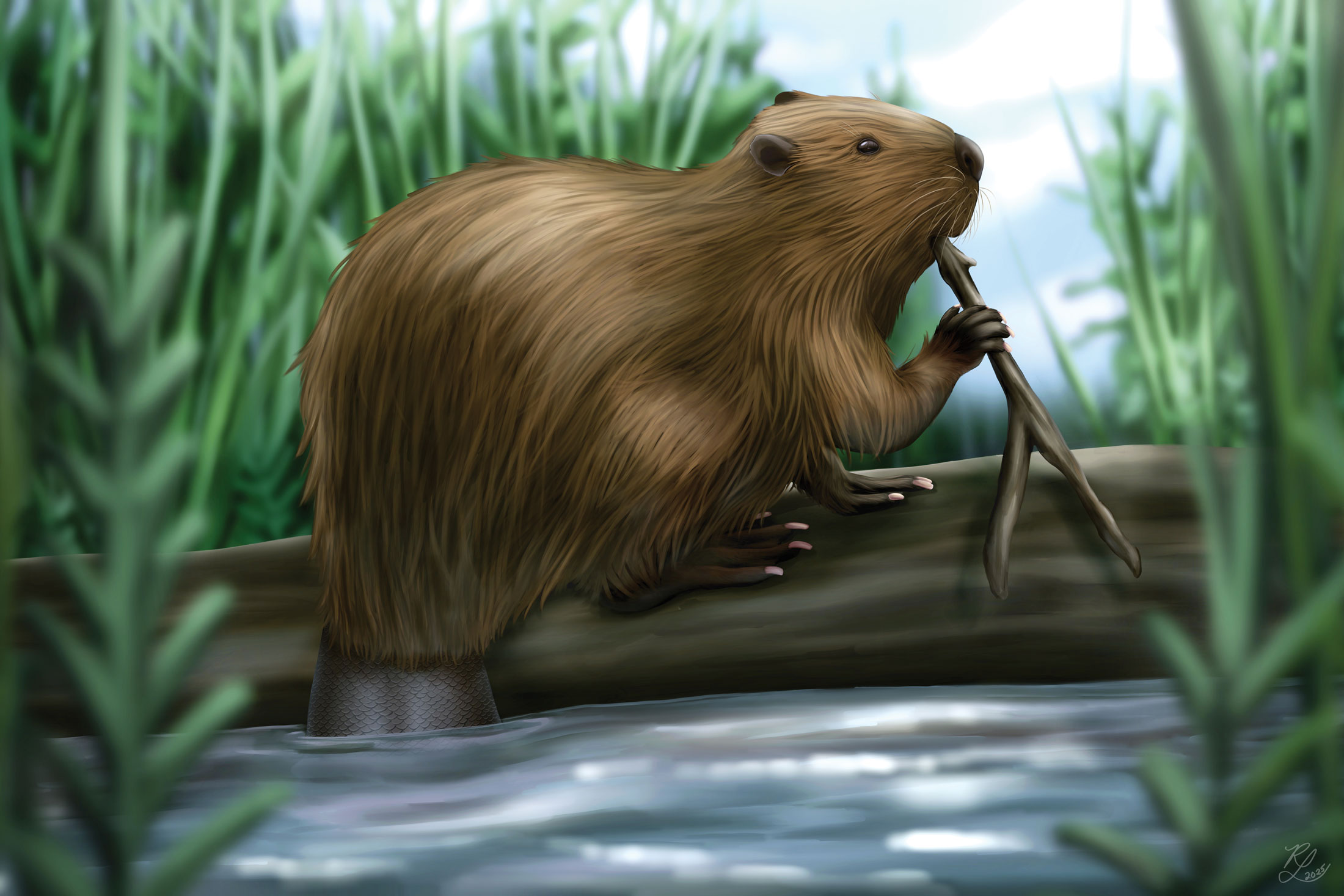
“We always want to try in science illustration to build those bridges between science and the general public, because I think it’s really the general public that’s the crux,” Lewis said. “If we can draw them in with a really cute picture of a beaver, and then use that as a jumping-off point to explain why they’re important, and then how that all ties back into the conservation of our natural land, that’s the thing I hope guests to the park will experience when they look at these illustrations.”
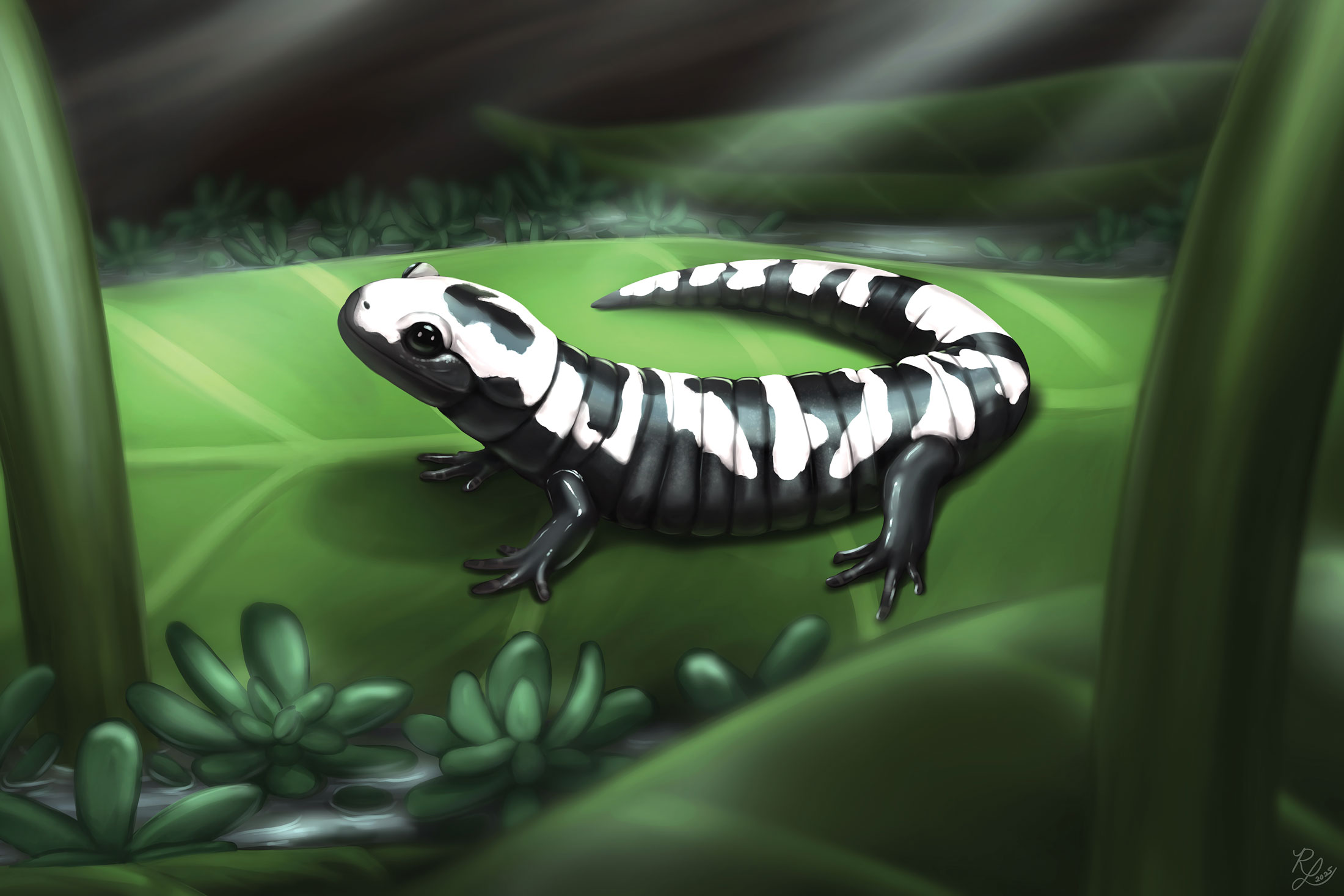
Lewis created her pieces using a digital illustration program, making it easy to share her work with the team and make adjustments based on their feedback. The result was eight richly colored and detailed pictures showcasing some of the unique plants and animals found in the Smokies’ wetlands—bog gentian, giant cane, grass of Parnassus, marsh bellflower, marbled and four-toed salamanders, American mink, and American beaver. Lewis said the beaver was one of her favorite drawings to work on; she’d grown to appreciate them over the years while observing their handiwork in the Patapsco River Valley near her home in Maryland.
“They build dams on the river, so I think it’s really, really fascinating to watch them be these ecosystem engineers where they can really change an entire landscape, so I really wanted to emphasize that with having the beaver holding a stick,” she said.
The plants, meanwhile, proved to be the toughest challenge. Lewis had never seen most of these species in person, so she was working strictly from reference photographs and her own research as she tried to figure out details such as exactly how the leaves attached to the stem.
Another challenge was the timeline. Lewis couldn’t start illustrating until Thompson finished shooting, providing her with photographic references to pull from when rendering the various wetland environments. And her schedule was cut short on the other end by a cross-country move one month before the deadline. Both Lewis and Bemis said they were pleased by how well they were able to navigate those challenges.
“Overall, it was an amazing experience—such a smooth process—and I’m honestly really proud of how the illustrations turned out,” Lewis said.
The finished piece is now displayed on an interior wall at the welcome center.
“Working collaboratively with the team allowed us to bring together all of our strengths and create something that feels both informative and genuinely engaging,” Bemis said. “It was so rewarding to watch our ideas gradually take shape and come together in a way that really highlights the beauty of the park’s wetlands and the species that depend on them.”
Great Smokies Welcome Center is located at 7929 E Lamar Alexander Parkway in Townsend, Tennessee. It is open daily from 9 a.m. to 5 p.m. March through November, closing at 4:30 p.m. the remainder of the year.
Subscribe to get the latest posts sent to your email.