


With the Christmas holiday approaching, I thought it only fitting to delve into the history of Christmas celebrations in the Great Smoky Mountains. Rather than consult our traditional archival collections, I decided to plumb the depths of the parks extensive oral history collection to learn how these mountain folk celebrated Christmas in the decades immediately before the establishment of the park. While some of these reminiscences reminded me of stories I’d heard growing up in Texas, others were certainly unique to Southern Appalachia, and some even prompted me to say “I had no idea.”
Food played a central role in Christmas celebrations in the mountains. Throughout the oral history recordings food is consistently the key memory shared by members of the isolated communities across this region. In a time when ready-made presents were unavailable or beyond the financial reach of all but the most fortunate, gifts of food were central to the holiday celebration. Winfred Cagle, who lived on Deep Creek in North Carolina, recalled how she and her siblings, as many as eight living at home at one time, would hang their socks across the mantle on Christmas Eve. Excited and unable to sleep any longer, they would rise at 3 or 4 o’clock in the morning to find their socks filled with English walnuts, Brazil nuts, pecans, and an orange or tangerine. Peppermint stick candy, chocolate drops, and one year a coconut were shared among the children.
Many children received gifts of food made by their family members as well. Wiley Oakley, the Roamin’ Man of the Mountains, recalled biting the heads off of the gingerbread men his wife baked for their children. “…no, they didn’t want them. They’d say now dad eat the rest of it since you bit the head off.” Greenbriar’s Glenn Cardwell remembered meager gifts in stockings on Christmas morning, but said they always woke to gingerbread and apple stack cakes on the table. Alice Newman Maples fondly recalled Christmas Eves spent eating sweet potatoes cooked in the coals of the fireplace as her grandfather spun yarns and told tall tales.
Lucinda Oakley Ogle, daughter of Wiley Oakley, described a particularly interesting Christmas tradition. According to Ogle “at Christmas time, there was an old custom that somebody said was handed down from the Black Dutch or from some country that we originated from that on Christmas morn the first one to get “Christmas gift” on the other, then they had to give you something.” Ogle would try to be the first person to visit her Aunt Lindy on Christmas morning and say “Christmas gift”. Aunt Lindy would then give her sweetbread dusted with fresh ground nutmeg. “To me that was the best tasting thing I ever had in my life”.
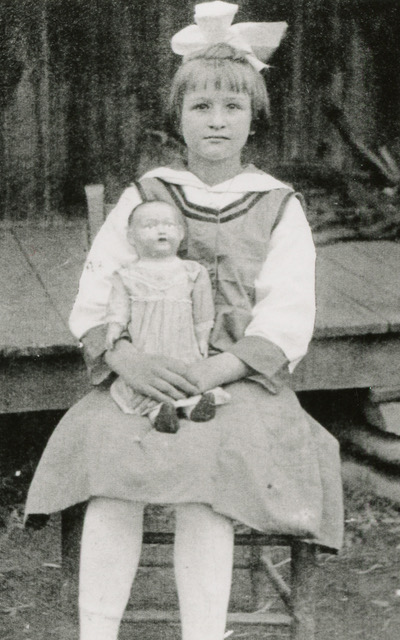
While many mountain children seldom received store-bought toys at Christmas, most received new boots or shoes. Knitted wool socks and scarves could also be found on Christmas morning. Elsie Burrell remembered receiving her only store-bought doll one Christmas from the girlfriend of the doctor who was treating her for typhoid fever. Jarvis Conner, from Bradley Fork in Smokemont, recalling times when his father was flush with cash, said he and his brother would receive “shot n’ powder, n’ caps” for their shotgun. Many years they received fireworks as well. As it turns out, fireworks were a regular part of Christmas celebrations in the mountains. Nicholas Oakely of Mill Creek remembered people setting off dynamite to celebrate the holiday. Cosby’s Herman Matthews, who also received roman candles and sparklers for Christmas, was unaware that fireworks were set off to celebrate Independence Day until he moved away from the mountains.
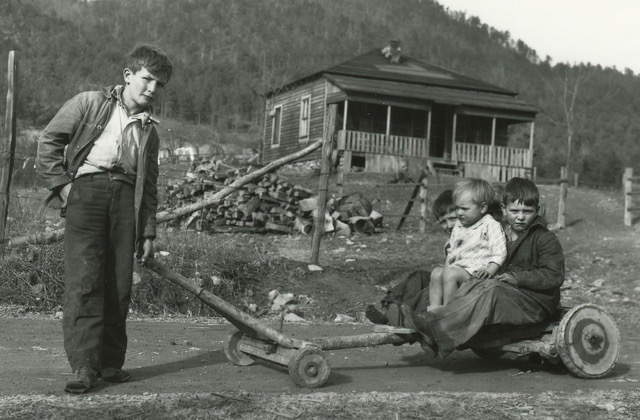
Children would sometimes make their own toys at Christmas. Glenn Cardwell was given wooden toys whittled by his older brother. Raymond Caldwell from Cataloochee remembered cutting down black gum trees and fashioning a “bulger” wagon from them. He would take a heated piece of iron and bore holes in the wheels for the axles, attach a platform made of planks to sit on, grease the axle with fat stolen from his mother’s kitchen, and play with the wagon until it broke.
Community played a central role in commemorating Christmas in the Smokies. It wasn’t common for the church to be the center of the communities Christmas observation. For example in Herman Matthews experience celebrating Christmas in the church was considered a sin. The school, however, was often the site of a large community gathering. Eugene Lowe, who lived on Noland Creek in North Carolina remembered pageants being held at his school, with a decorated tree, singing, food, and small gifts. Winfred Cagle recalled a year when a large cedar tree was brought into the school and the community gathered to help decorate it. Popcorn and holly berries were strung on thread, a multi-colored chain of crepe paper was draped on the branches, and the boughs were decorated with mistletoe. Gifts of food were exchanged, canned goods placed under the tree for those who experienced a bad year, and candy was available for the children.
The common thread found in all of these oral histories is that in reflecting on Christmas celebrations in the mountains, these people were thankful for what they had and didn’t lament those things they didn’t. Perhaps you can’t miss what you’ve never had. It’s clear that those things they did have, family and community, were at the heart of their holiday celebrations.
Mike Aday is the librarian-archivist at the Collections Preservation Center, where artifacts from Great Smoky Mountains National Park are housed. The Collections Preservation Center existence was partly made possible through funding from Great Smoky Mountains Association. Email Mike HERE or call M-F, 9 a.m. to 3 p.m. at 865-448-2247.
Subscribe to get the latest posts sent to your email.