



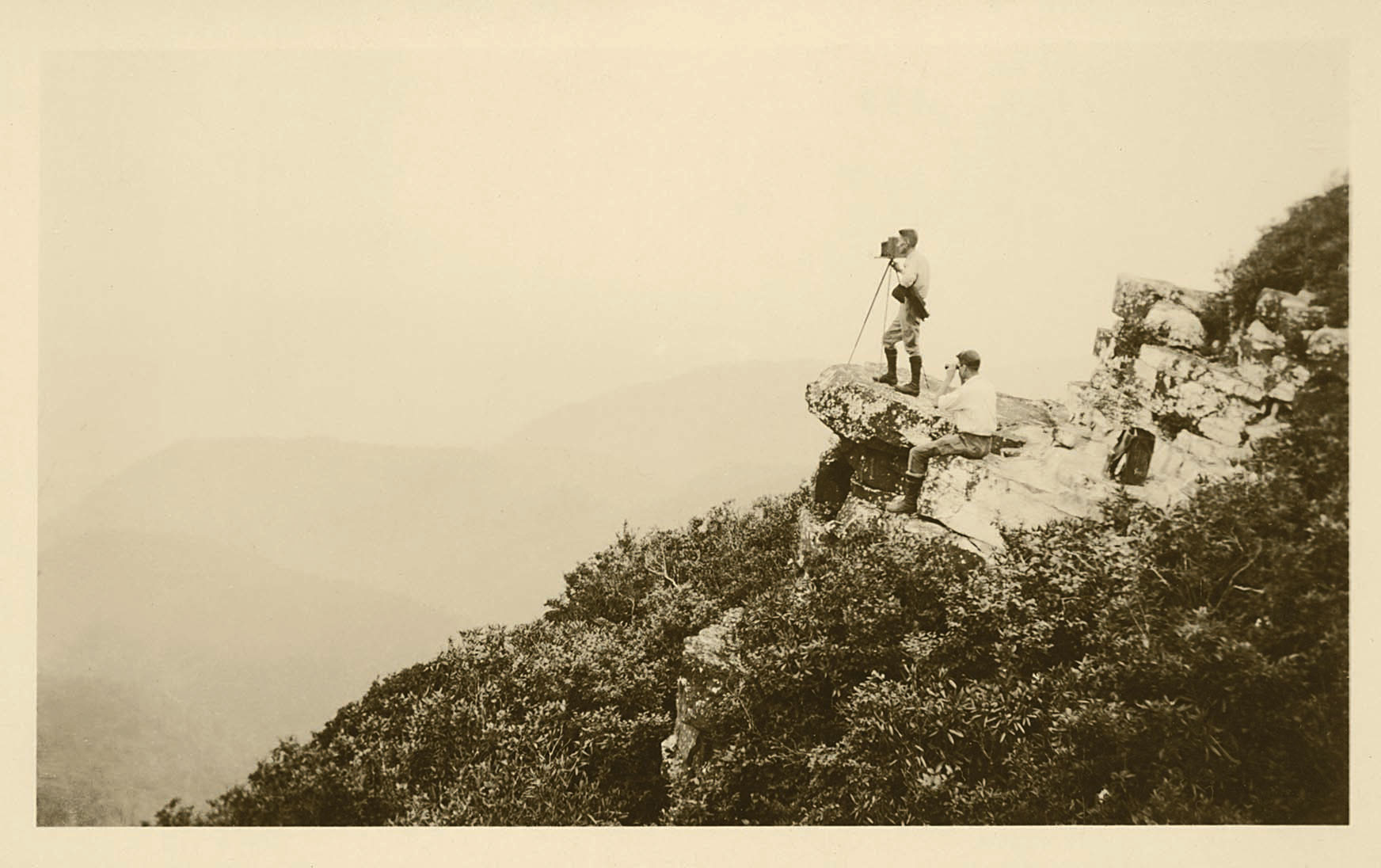

I have always been intrigued by mysteries and unique discoveries such as the legends of lost mines and the petroglyphs on Western North Carolina’s Judaculla Rock, but I never expected to acquire a similar mystery of my own. Nevertheless, while conducting research nearly 30 years ago about George Masa, acclaimed Great Smokies photographer, I discovered an archeological mystery in his correspondence.
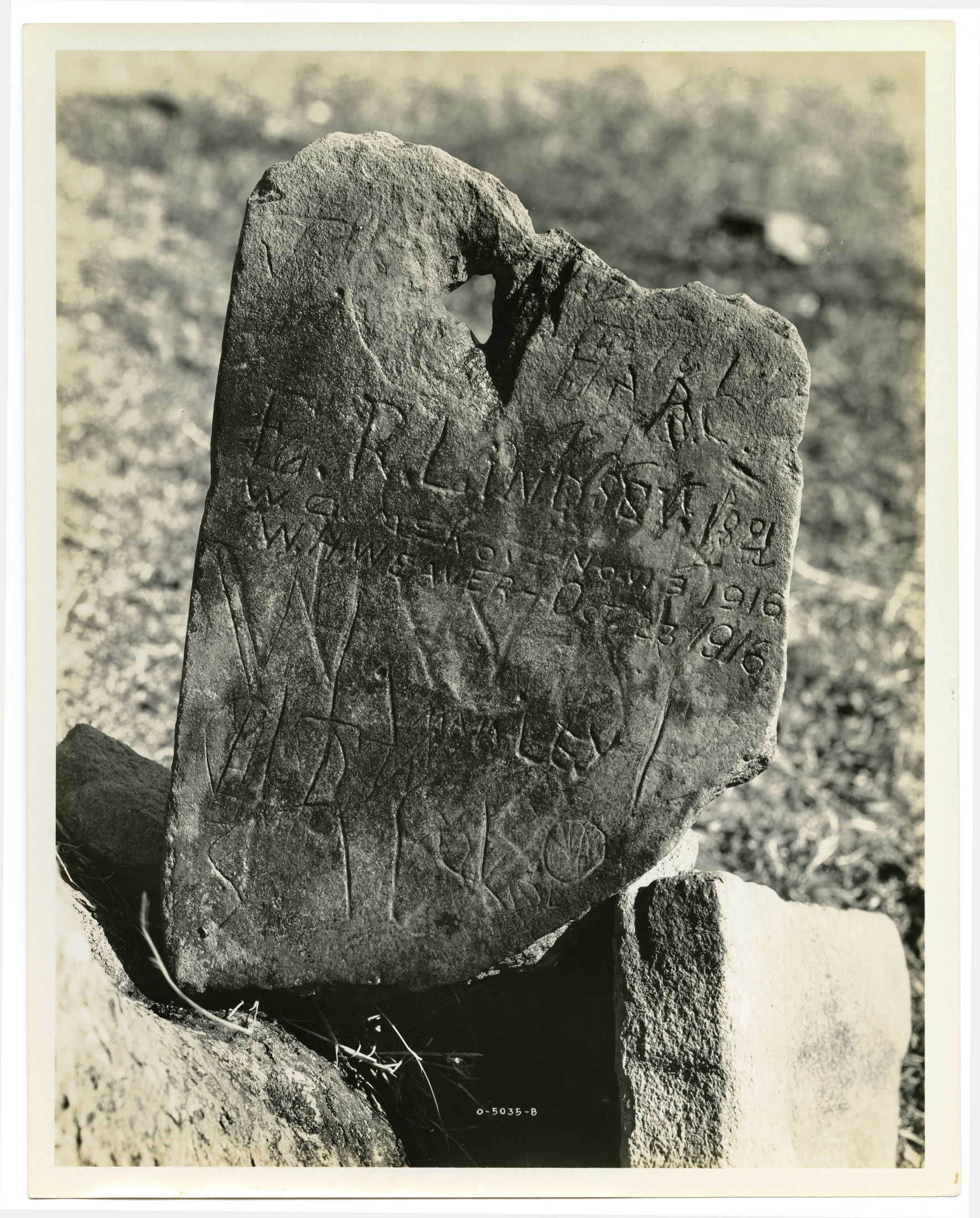
Three letters mentioned a D-shaped rock, slightly larger than a sheet of notebook paper, found in Porters Gap, a high gap in Great Smoky Mountains National Park 5.4 miles east of Newfound Gap. I would come to discover that Masa was so fascinated by the graffiti-covered rock that he sketched and photographed it.
The first letter about the find, dated March 2, 1931, was from Masa’s friend C. W. “Charlie” Conner. Conner wrote, “I still hav [sic] the Rock and sure I will put it in the museum in the Park when they start it so I will take good care if it.” These words set my mind awhirl with questions and created a keen desire to discover the rock. I had acquired my mystery!
The second letter I came across, dated March 11, 1930, was from Paul Fink, a friend of Masa’s, who stated he had seen the rock in Porters Gap in 1919. He added, “You are exactly right in keeping it for the National Park Service, for it will be an interesting exhibit for the museum they will undoubtedly establish.”
The third, dated March 21, 1930, was from Arno Cammerer, associate director of the National Park Service. “I see now by your letter (containing a photograph), that it was a rock with some historical significance. I realize how careful you were in attempts to protect it, but I think the best thing we can do after the park is established is to get a horse and have it taken back to about where you found it.”
Although the current whereabouts of the mystery rock eluded me, I researched its home and discovered that Porters Gap has important historical ties. In Hiking Trails of the Great Smoky Mountains, Ken Wise states that Porters Gap was named for James P. H. Porter, who used a trail there when traveling to North Carolina. William Davenport stopped in Porters Gap on July 30, 1821, while surveying the dividing line between North Carolina and Tennessee. And hikers D. R. Beeson and Hodge Mathis noted in 1914 that a trail crossed the gap, marked by an “old broken tombstone” with “initials carved thereon.” Obviously, Porters Gap was a well-recognized landmark where travelers left signs marking their passage.

In 2005, I shared my research with Eric Kreusch, a park archeologist who contacted the National Archives seeking Masa’s photo of “rock art” in Cammerer’s files. No record was found. I was stymied. Four years later, however, a phenomenal discovery revived my search. A collection of Masa photographs was discovered in 2009, and I was privileged to see them, thanks to Libby Kephart Hargrave, great-granddaughter of writer Horace Kephart. Two photos of rocks emerged in the set. One of them was my mystery rock!
My final quest was to find the rock itself. In March 2021, I shared my research with Michael Aday, librarian–archivist at the NPS Collections Preservation Center in Townsend, Tennessee, and requested his assistance. He sent good news.
“William, thanks for the letter concerning the mystery rock,” he wrote. “We have in our artifact collection the rock that George Masa photographed that has a hole in it . . . I’m attaching an image for your perusal. All I can tell you about it is that it was catalogued into the collection by Hiram Wilburn in 1934 and it was identified by Charlie Conner.”
The photo of the archived rock, about 13 inches tall and 10 inches wide, confirmed the find. It matched Masa’s photograph, with two differences: a harness strap had been threaded through the bullet hole for ease in carrying, and a new name had been added—“Wiley.”
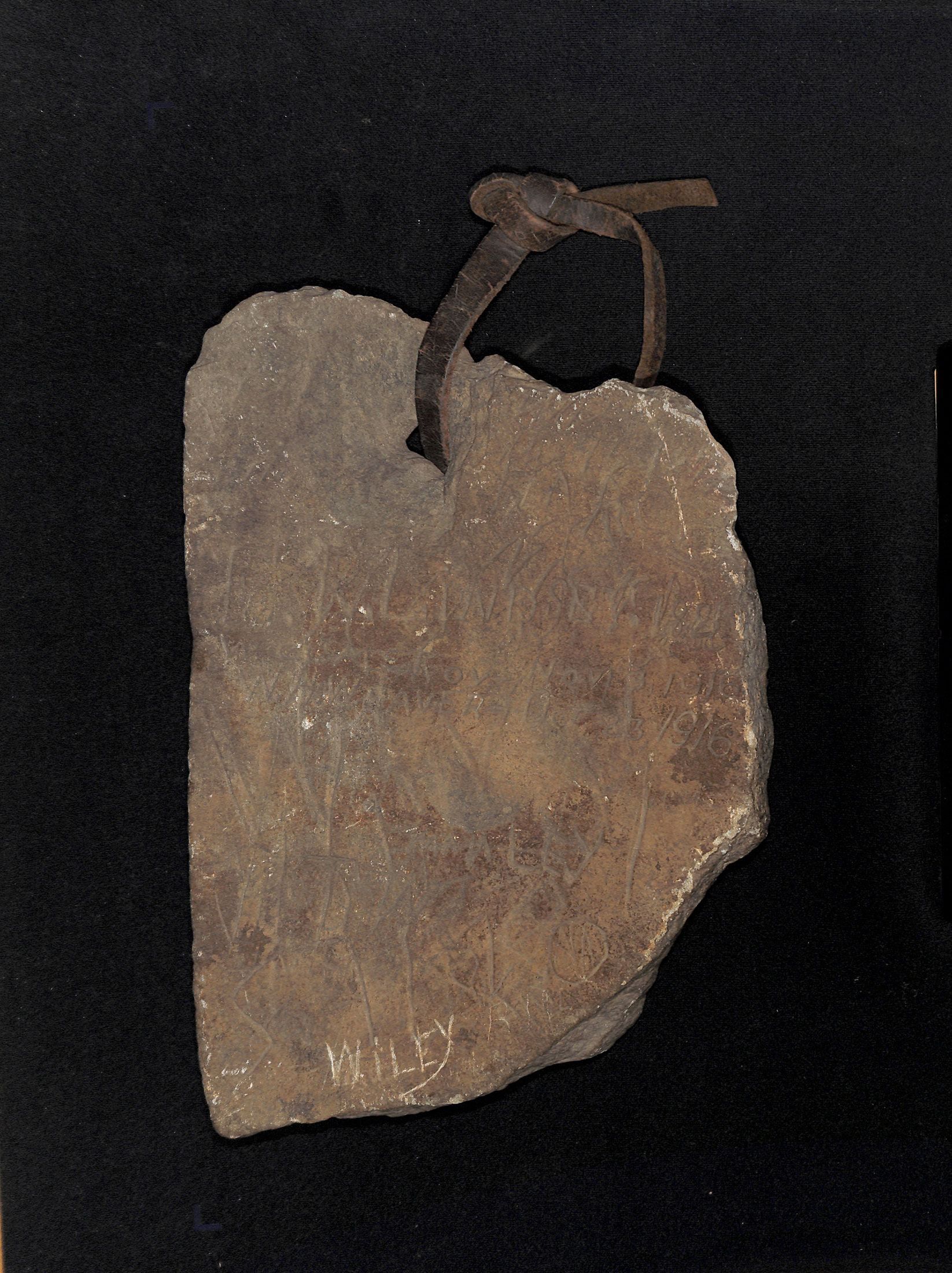
In May 2022, my wife Alice and I traveled to the archive and examined “Masa Rock,” as I now called it, awed by its significance and history. Each of its markings represented a human visit and a story unto itself. Its names, dates, and unfamiliar shapes were intriguing. Some may have been left by Native Americans. And others by hunters, surveyors, and hikers who passed through Porters Gap. Our time, reverently spent with Masa Rock, marked the momentous end of my quest and the satisfying solution to my mystery.
Although my quest had ended, unexpected discoveries still awaited.
Janet McCue, coauthor of George Masa: A Life Reimagined, shared two pages from Masa’s pocket notebook dated September 3, 1929, with his sketches of rocks in Porters Gap. Angelyn Whitmeyer, creator of the George Masa Photograph Database, provided his September 1929 hiking itinerary, and Jason Brady, a specialist in Special and Digital Collections at Western Carolina University, contributed vital Masa notebook content. These resources enabled me to reconstruct Masa’s trip to Porters Gap and bring the day vividly to life.
The account that follows relies on Masa’s pocket notebook; my research, interpretation, and suppositions; and a final word from Hiram Wilburn, who collected Masa Rock from Charlie Conner in 1934.
On September 2, 1929, Masa, Conner, John Carroll, and Frank Whaley camped in North Carolina’s Kephart Prong watershed near Mud Creek (now Hunter Creek). On September 3, the party climbed to a point near the state line, turned right, and continued to Dry Sluice Gap. After a diversion to climb “Bare Rock Ridge,” today recognized as Charlies Bunion, they crossed the Sawteeth and reached Porters Gap at 11:30 a.m. Masa sketched and photographed the rocks there, and the group departed at 12:45 p.m., taking Masa Rock with them. Afterwards, they walked east, descended to Bradley Fork, and camped at Upper Louie Camp.
Hiram Wilburn’s notation on the archive’s collection record adds the final touch. He said that Conner, who guided the party, found the stone under a beech tree root about 100 feet from the top, on the North Carolina side of Porters Gap. At the end of the day, the party joined Horace Kephart for the evening at Upper Louie Camp. I can easily envision these friends sitting around their campfire as day ended discussing the Porters Gap rock. Perhaps they were as captivated by its mystery as I have been.
Today, Masa Rock serves as a chronicle of human travel on a rugged, remote crest in the Great Smokies. I’m certain Masa and Conner would be gratified to know the rock is preserved in a permanent, secure home in the park archives.
The best way to remember a discovery is by taking a picture and informing park staff if you believe the find is significant. Removing any natural or manmade objects from a national park is strictly prohibited, as is carving or writing on any object or natural resource.
Subscribe to get the latest posts sent to your email.